SURFACE

Integrated forecast

Reservoir tanks, wells and the surface network run together through time, so a change in one shows up in the others. Schedule events, hold a plateau, honour constraints, screen development options by NPV and put P90/P50/P10 bands on the forecast.

Models coupled: tanks, wells and network
3
Agreement with Converge's own material balance
0.1 psi
Latin hypercube realisations by default
100
Variables screened at once, ranked by NPV
3
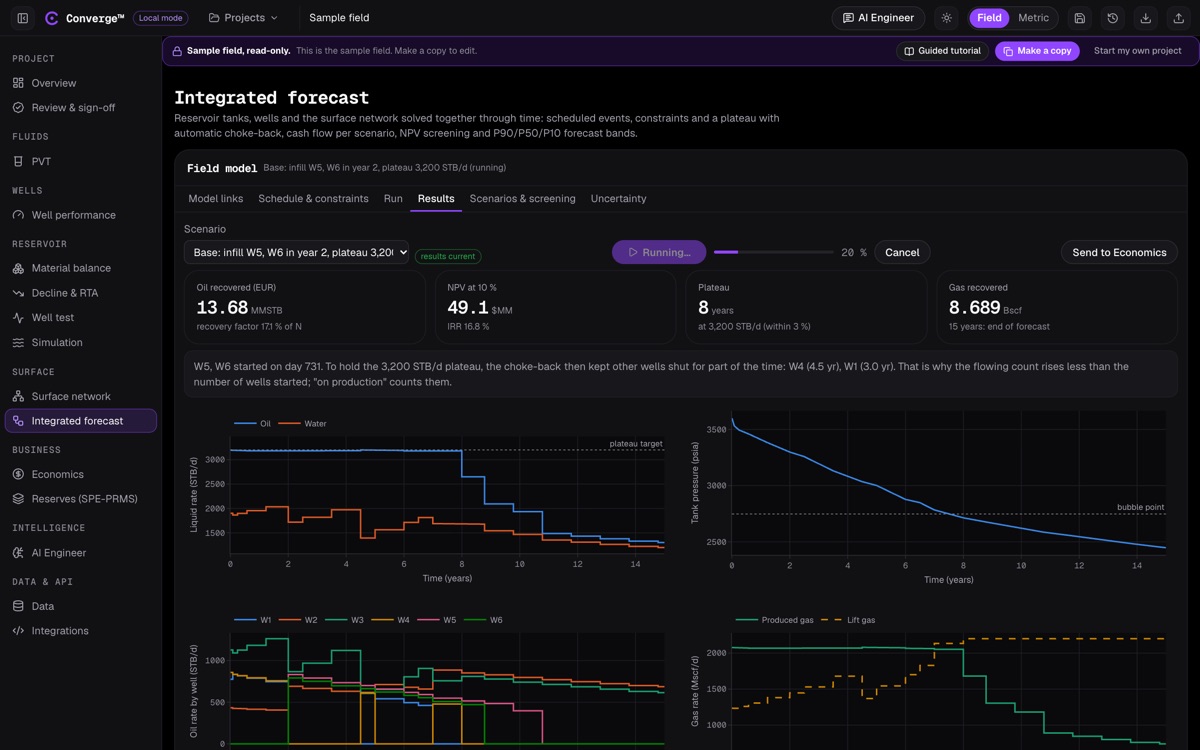
Converge integrated forecast results: oil recovered, NPV, plateau length and gas recovered across the top, with oil and water rate against a plateau target, tank pressure, per-well oil rates and gas rates.
The sample field's base case: a 3,200 STB/d plateau held for eight years by choking wells back, with NPV at 10%.

WHAT IT DOES

The field forecast, solved as one system

Forecasting the reservoir, the wells and the surface separately misses the interactions that decide a plateau: as reservoir pressure falls the wells deliver less, the network back-pressure changes, and the constraint that binds moves. The integrated forecast couples them through time.

At each step, every well receives its tank's pressure, water cut and GOR, the network is solved with those wells, and exactly what the network delivered is withdrawn from the tanks. An explicit scheme holds rates over the step; an iterative predictor-corrector converges pressure and rate together. Either way mass is conserved to round-off, and a PI controller on the coupling error sizes the time steps.

On top sit the controls a development plan uses: a field plateau target, choke-back when a constraint binds, lift-gas re-optimisation, well limits and scheduled events. Scenarios compare against a base case, full-factorial screening ranks options by NPV through the Economics engine, and Latin hypercube sampling gives P90, P50 and P10 bands.
At a glance

  • Material-balance tanks with aquifers
  • Wells and the surface network solved each step
  • Explicit or iterative predictor-corrector coupling
  • Mass conserved to round-off
  • PI-controlled time steps with step rejection
  • Field plateau target
  • Choke-back, pro rata or worst well first
  • Lift-gas re-optimisation every N days
  • Scheduled events: wells, chokes, compressors, constraints
  • Scenario comparison against a base case
  • Full-factorial screening ranked by NPV
  • Latin hypercube P90/P50/P10 bands

KEY CAPABILITIES

Coupling, controls, scenarios and uncertainty

Coupling

The loop that ties the tanks to the wells and the network.

  • Each step: apply events, give wells their tank pressure, water cut and GOR, solve the network, withdraw what it delivered
  • Explicit (lagged) coupling, rates held over the step
  • Iterative predictor-corrector with a weighting factor θ, iterated to tolerance
  • Mass conserved to round-off in both schemes
  • PI controller on the coupling error (Redick and Gildin 2018), with step rejection
  • Steps cut to land exactly on events

Reservoir side

The matched material-balance tanks, carried forward.

  • Material-balance tanks with their aquifers
  • Corey fractional flow for water cut and GOR
  • Well PI held constant or scaled with mobility
  • Injection into a tank as a scheduled event

Controls and events

The operating decisions of a field development plan.

  • Field plateau target
  • Network constraints honoured by choking wells back, pro rata or worst well first
  • Lift-gas re-optimisation every N days
  • Well limits on oil rate, water cut and GOR, and a field minimum oil rate
  • Events: well on or off, choke size, lift-gas rate, separator pressure, a new compressor, a changed constraint or plateau

Scenarios and screening

Compare development options on production and value.

  • Every scenario run, with a delta view against a chosen base
  • Full-factorial screening over one to three variables
  • Well count, compression year and lift-gas availability as variables
  • Options ranked by NPV through the Economics engine, including the PIA 2021 terms

Uncertainty

A range on the forecast, from the inputs that matter.

  • Latin hypercube sampling, 100 realisations by default
  • In-place volume, aquifer strength, PI, skin, Corey exponents and uptime
  • P90, P50 and P10 bands at each time

Results

What the plan delivers, and why.

  • Rates, tank pressures and per-well rates through time
  • Plateau length and year-end wells flowing
  • Oil and gas recovered and NPV
  • A plain-language explanation of choke-back decisions
  • Coupling log as CSV

WORKFLOW

From linked models to a ranked plan

  1. Link the models

    Choose the project's material-balance tank, network and economics case. A link that cannot be used blocks the run, with the reason.

  2. Schedule events

    Add wells coming on, compressor installs, choke changes and constraint changes through time.

  3. Set controls and coupling

    Set the plateau, the choke-back rule, lift-gas re-optimisation and the coupling scheme.

  4. Run

    Run in the background and watch the coupling log live.

  5. Compare and screen

    Compare scenarios against the base, screen up to three variables by NPV, and run the uncertainty bands.

  6. Send to Economics

    Send the chosen profile to the Economics module.

VALIDATION

Consistent with the models it couples

The integrated forecast conserves mass to round-off and agrees with Converge's own material balance within 0.1 psi.

There is no external comparison with another integrated-asset tool yet, and the benchmarks page lists it as outstanding. The forecast couples material-balance tanks; it is not coupled to the grid simulator.

INPUTS AND OUTPUTS

What goes in, what comes out

Inputs

  • A matched material-balance tank with its aquifer
  • The surface network and its wells
  • An economics case for prices, costs and fiscal terms
  • Scheduled events and constraints
  • Uncertainty ranges for screening

Outputs

  • Field and well rates and tank pressure through time
  • Plateau length and year-end wells flowing
  • Oil and gas recovered and NPV per scenario
  • Scenario deltas and screening rankings
  • P90, P50 and P10 bands

Exports

  • Coupling log CSV
  • Production profile sent to Economics
  • integrated.run over the REST API and MCP

FAQ

Integrated forecast: common questions

What reservoir model does the integrated forecast couple?

Material-balance tanks with their aquifers, using Corey fractional flow for water cut and GOR. It is not coupled to the grid simulator.

Is the coupling explicit or implicit?

Both are available. Explicit coupling holds rates over the step; the iterative scheme is a predictor-corrector that converges pressure and rate together. Mass is conserved to round-off either way.

How are network constraints honoured?

Wells are choked back when a constraint binds, either pro rata or worst well first, and the results explain which wells were held back and for how long.

Can I screen development options?

Yes. Full-factorial screening over up to three variables, such as well count, compression year and lift-gas availability, ranked by NPV through the Economics engine.

How is forecast uncertainty handled?

Latin hypercube sampling over in-place volume, aquifer strength, PI, skin, Corey exponents and uptime, 100 realisations by default, giving P90, P50 and P10 bands.

Forecast the field as one system.