FLUIDS

Black-oil PVT

When a full composition is more than the job needs, start from oil gravity, gas gravity and GOR. Published correlations give oil, gas and water properties against pressure, checked against your lab points and ready for every module and your simulator.

Oil correlation sets, ranked against your lab points
5
Table points below and above the bubble point
16 + 8
Worst Z-factor difference in the benchmark
0.03%
Unit systems for every export: field and metric
2
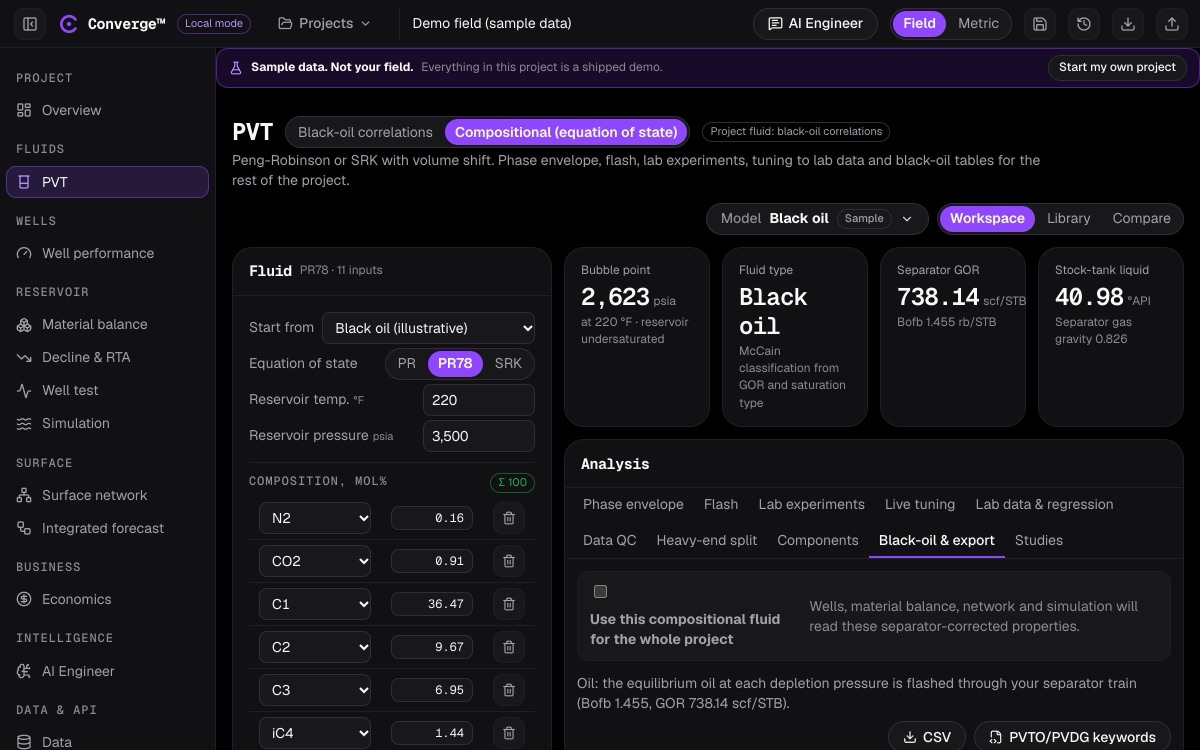
Converge black-oil and export screen: oil formation volume factor, solution GOR and viscosity against pressure, with a table of black-oil properties and export buttons.
Separator-corrected black-oil tables, ready to export.

WHAT IT DOES

Fluid properties from four numbers, checked against the lab

Black-oil PVT treats the reservoir fluid as stock-tank oil, surface gas and water, with gas dissolving in the oil as pressure rises. Enter the oil API gravity, the gas specific gravity, the producing GOR, the reservoir temperature and any CO₂, H₂S and N₂, and Converge computes the bubble point, solution GOR, formation volume factors, densities, compressibilities and viscosities across the pressure range.

Five sets of published oil correlations are available. Paste measured points from a lab report and Converge ranks the sets by how well each reproduces them, then lets you tune the chosen set: an Rs shape exponent, and a multiplier and shift for the formation volume factor and for viscosity. Differential-liberation data are converted to a separator basis before they are compared.

For simulator work, the tables come from the tuned equation-of-state fluid: the equilibrium oil is flashed through your separator train rather than the reservoir flash, which is how the volumes a simulator reports match what the separators will measure.
At a glance

  • Standing, Vasquez-Beggs, Glasø, Petrosky-Farshad and Al-Marhoun oil sets
  • Beggs-Robinson, Vasquez-Beggs and Beal viscosity
  • Dranchuk-Abou-Kassem Z-factor with Sutton pseudo-criticals
  • Wichert-Aziz correction for CO₂ and H₂S
  • Lee-Gonzalez-Eakin gas viscosity
  • McCain water properties
  • Automatic ranking of correlation sets against lab points
  • Tuning of Rs, Bo and viscosity to the lab
  • Separator-corrected tables from the EOS fluid
  • PVTO, PVDG, PVTW, PVTG and RSVD exports

KEY CAPABILITIES

Correlations, tuning and simulator tables

Oil correlations

Bubble point, solution GOR and oil formation volume factor come from one of five published correlation sets, chosen by you or by fit to your lab points.

  • Standing
  • Vasquez-Beggs
  • Glasø
  • Petrosky-Farshad
  • Al-Marhoun
  • A measured bubble point is honoured when you have one

Viscosity and interfacial tension

Dead-oil, saturated and undersaturated viscosity are computed separately, as the published methods intend.

  • Beggs-Robinson dead and live oil
  • Vasquez-Beggs above the bubble point
  • Beal dead-oil viscosity
  • Baker-Swerdloff interfacial tension

Gas and water

Gas properties use pseudo-critical correlations with a correction for sour and inert components, and water properties follow McCain.

  • Sutton pseudo-critical properties, mixed by Kay's rule
  • Wichert-Aziz correction for CO₂, H₂S and N₂
  • Dranchuk-Abou-Kassem Z-factor
  • Lee-Gonzalez-Eakin gas viscosity
  • McCain water formation volume factor, compressibility and viscosity

Tuning to lab points

Correlations are a starting point. When you have measurements, Converge measures the gap and closes it.

  • Auto-pick ranks the five oil sets by fit to the lab points
  • Rs shape exponent fitted to the measured solution GOR
  • Multiplier and shift on the oil formation volume factor and on viscosity
  • Differential liberation converted to a separator basis (McCain 1990) before comparison
  • Lab match plots and tables

Separator-corrected tables

Black-oil tables for simulators come from the tuned equation-of-state fluid, flashed through the separator train you define.

  • The equilibrium oil at each pressure is flashed through the separators
  • 16 points up to the bubble point and 8 above it
  • Wet-gas tables built from a constant volume depletion
  • RSVD and RVVD from composition against depth

Simulator exports

Every deck is written in field or metric units, ready to include in a simulator data file.

  • PVTO, PVDG, PVTW and DENSITY for oil
  • PVTG and PVTO for wet gas and condensate
  • *PVT keyword-format black-oil table
  • Tab-separated tables for nodal, material-balance and network tools
  • CSV of every table

WORKFLOW

From surface data to a simulator deck

  1. Describe the fluid

    Enter API gravity, gas gravity, GOR, reservoir temperature and any CO₂, H₂S and N₂.

  2. Pick or rank correlations

    Choose a correlation set, or paste lab rows and let Converge rank the five sets by fit.

  3. Tune to the lab

    Fit the Rs exponent and the Bo and viscosity adjustments to the measured points, if you have them.

  4. Set the project fluid

    Make the fluid the project fluid, so every module reads the same properties.

  5. Export

    Download CSV tables, or simulator decks from the equation-of-state workspace.

VALIDATION

Every correlation checked against its hand calculation

Each correlation set is checked against a hand calculation from the published equations, and the Z-factor against the published method at four pressures. Values are in oilfield units, as the references give them.

CheckReferenceConvergeTolerance
Standing bubble point, 35 °API, gas gravity 0.75, 650 scf/STB, 200 °F (V1)2,748 psia2,747.8 psia±1.6 psi
Standing oil formation volume factor at the bubble point (V3)1.375 rb/STB1.3749 rb/STB0.0005 rb/STB
Beggs-Robinson live-oil viscosity at the bubble point (V4)0.4927 cp0.4924 cp0.1%
Z-factor, Dranchuk-Abou-Kassem with Sutton, gas gravity 0.7, 200 °F, at 1,000 to 10,000 psia (V6)Published method0.01–0.03%0.05%
McCain water-viscosity pressure correction at 5,000 psia (V7)+28%+28%±0.5 point
Gas formation volume factor at 3,000 psia (V9)0.000983 rb/scf0.000983 rb/scf10⁻⁶ rb/scf

The other four oil sets each match their hand calculation, and every bubble point inverts back to the input GOR.

INPUTS AND OUTPUTS

What goes in, what comes out

Inputs

  • Oil API gravity and gas specific gravity
  • Producing GOR and reservoir temperature
  • CO₂, H₂S and N₂ mole fractions
  • Measured bubble point, if known
  • Lab points for Rs, Bo and viscosity

Outputs

  • Bubble point and solution GOR
  • Oil, gas and water formation volume factors
  • Densities, compressibilities and viscosities against pressure
  • Z-factor and gas viscosity
  • Lab match plots and error tables

Exports

  • PVTO, PVDG, PVTW and DENSITY (.inc)
  • PVTG and PVTO for wet gas and condensate
  • *PVT keyword-format table (.dat)
  • RSVD and RVVD initialisation tables
  • Tab-separated tables for nodal, material-balance and network tools
  • CSV: pvt-table.csv and the EOS black-oil table

FAQ

Black-oil PVT: common questions

Which black-oil correlations are available?

Standing, Vasquez-Beggs, Glasø, Petrosky-Farshad and Al-Marhoun for the oil; Beggs-Robinson, Vasquez-Beggs and Beal for viscosity; Dranchuk-Abou-Kassem with Sutton pseudo-criticals and the Wichert-Aziz correction for gas; McCain for water.

How does Converge choose a correlation for my fluid?

Paste your lab points and auto-pick ranks the five oil sets by how well each reproduces them. You can accept the best fit or choose another, then tune it.

What is a separator-corrected black-oil table?

A table in which each pressure's equilibrium oil is flashed through your separator train, rather than straight to stock-tank conditions in one step. Formation volume factors and GOR then match what the separators will measure.

Can I export black-oil tables for a reservoir simulator?

Yes. PVTO, PVDG, PVTW and DENSITY, or PVTG and PVTO for condensates, plus RSVD and RVVD and a *PVT keyword-format table, all in field or metric units. The decks come from the equation-of-state workspace; correlation mode exports CSV.

Does it handle sour gas?

Yes. The Wichert-Aziz correction adjusts the pseudo-critical properties for CO₂ and H₂S, and N₂ is included in the mixing.

Four numbers in, every property out.